
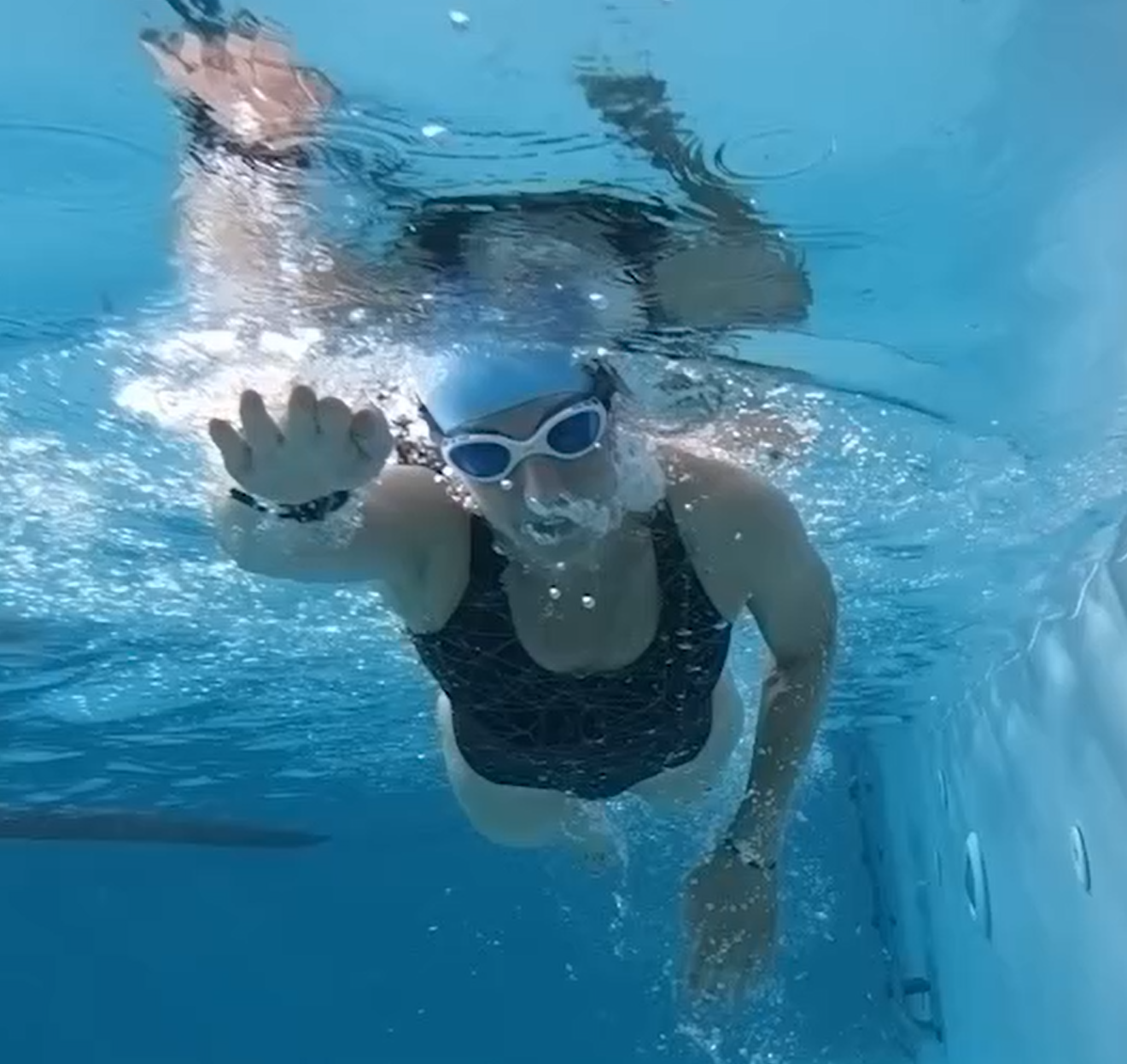
Swim S&C Screen | Distance Freestyle Assessment
£160.00
A dry-land screen built specifically for distance freestyle, not a generic athletic screen with swimming bolted on. Eighteen tests across the shoulder, thoracic spine, neck, core, hip and ankle, every asymmetry read against your habitual breathing side — because that’s what actually drives imbalance in this stroke, not which hand you write with. Uses the same IMU sensors already used for your swim video analysis, so the kit doing the work in the pool does double duty here.
Beschrijving
Distance freestyle asks something specific of the body: thousands of repeated head turns to breathe, a stroke driven by rotation as much as pull, and a shoulder doing more total work over a long swim than almost any other joint in sport. A generic strength screen doesn’t know any of that. This one is built around it.
Who this is for
Distance freestyle swimmers (400m and up, or open water) who want to know what’s actually limiting stroke efficiency or building toward a shoulder problem before it costs them training time — particularly relevant if you’ve got a recurring shoulder niggle, feel like your stroke breaks down late in longer swims, or have never had your dry-land mobility and control actually tested against what this specific stroke demands.
What’s included
– Shoulder (6 tests) — internal/external rotation range, posterior cuff and deltoid endurance (fatigue resistance matters more than peak strength here, since it’s the shoulder losing position deep into a swim that drives overuse injury), scapular control, lat and pec length, and lat and shoulder strength. Weighted as the single biggest factor in your overall score — the shoulder is both the propulsive engine and the primary overuse site in this stroke.
– Thoracic spine & neck (3 tests) — thoracic rotation (the single biggest mobility lever on stroke length — restricted mid-back rotation limits body roll and forces the shoulders and neck to compensate), thoracic extension, and cervical rotation (read specifically against your breathing side, given how many thousand times you turn your head per session).
– Core (4 tests) — prone plank and side plank endurance, an anti-rotation hold (the control half of body roll — mobility without the ability to resist unwanted rotation just leaks energy), and single-leg squat/step-down control.
– Hip (1 test) — hip abductor strength, since weak abductors let the pelvis drop and undermine the stable base your body roll is driven from.
– Ankle (2 tests) — dorsiflexion and plantarflexion range, relevant to push-off, turns and streamline position.
– Movement (2 tests) — an overhead squat used as a whole-chain triage tool (a compensation pattern here points to a specific limiter elsewhere, then the relevant test above confirms it), and single-leg balance for the proprioceptive control that underpins a stable, coordinated stroke.
What you get
A written report with every test scored Green/Amber/Red, read left-vs-right and against your breathing side specifically — an asymmetry that lines up with your breathing side tells a different story than one that doesn’t, and the report makes that distinction rather than flattening it into a generic imbalance flag. A single overall readiness score, weighted toward the regions that matter most for this stroke. And a corrective prescription built from corroborated findings — where a compensation pattern on the movement screen and a matching flag on the specific test behind it agree, that’s treated as a real, prioritised finding, not just one number among many flagged amber.
Gerelateerde producten
-

Proprietary Hydration Test
Prijsklasse: £100.00 tot £150.00 Select options Dit product heeft meerdere variaties. Deze optie kan gekozen worden op de productpagina -
VO2 Peak (Max) Assessment
£125.00 Select options -
Advanced Running Gait Analysis
£295.00 Select options -
Aerodynamic Cycling Assessment
£450.00 Select options
 Nederlands (België)
  English (UK)
  Français
  Deutsch
  Español
  Italiano