
Muscle Oxygen (Moxy) Assessment
£100.00
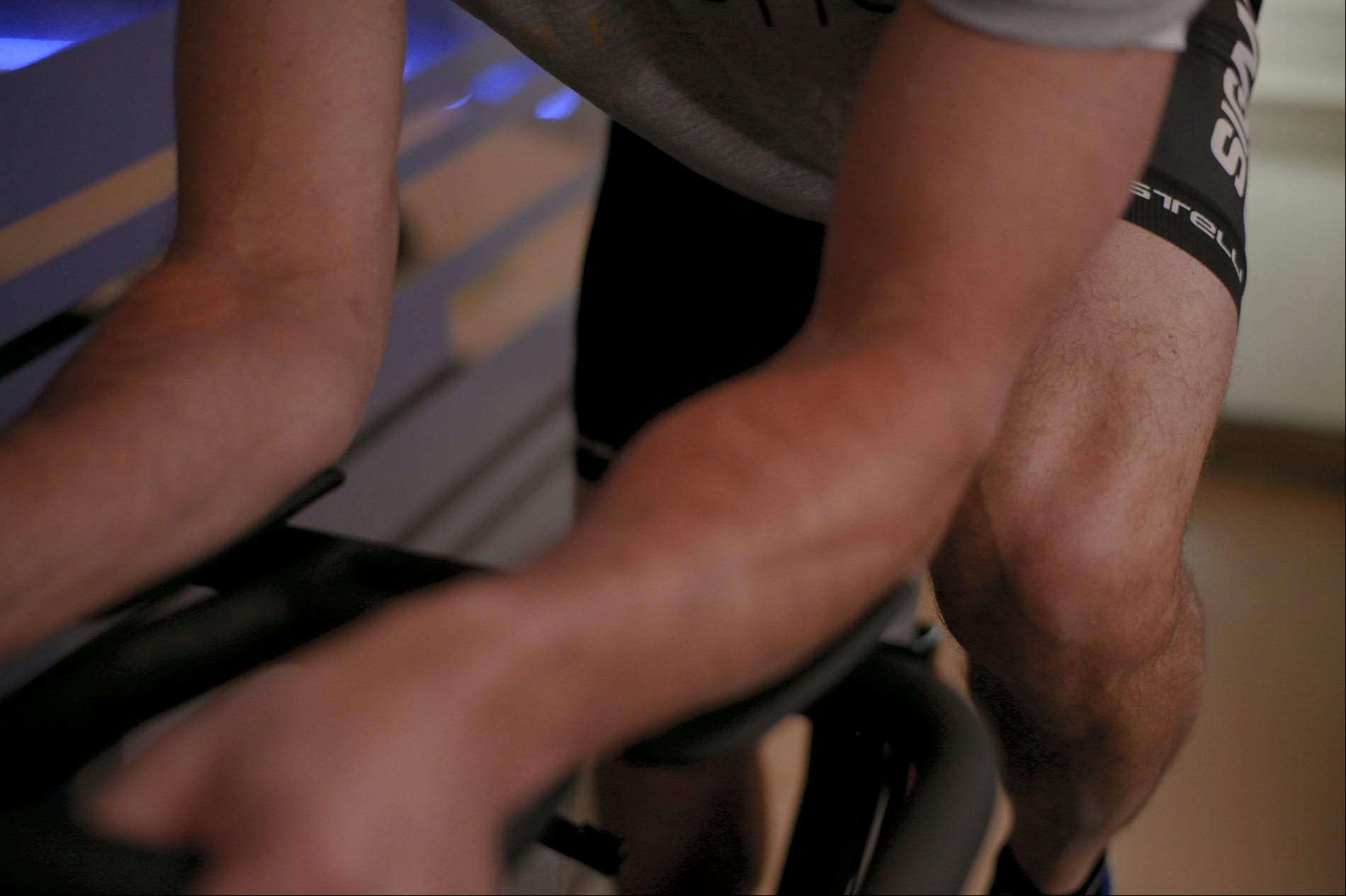
A wearable sensor read of oxygen delivery and use in the exact muscle doing the work — not a whole-body average. Our standalone assessment runs a full 3-sensor setup: both sides of your primary muscle plus one further point in the kinetic chain, showing not just how that muscle performs but whether one side is compensating for the other, and which muscle actually gives out first. Non-invasive, no blood draw, no mask. For cycling, running, swimming, rowing, climbing, or the gym.
Beschreibung
Most physiological tests give you one number for your whole body — VO2, heart rate, lactate. They tell you how the system copes overall, but not which specific muscle is actually the one giving out first, or whether your left and right sides are pulling their weight equally.
This assessment uses two to three wireless sensors simultaneously — both sides of your primary working muscle (quad for cycling, calf for running, lat for swimming) plus one further muscle in the kinetic chain — reading oxygen saturation and blood-flow trend at each site, live, throughout the session. No blood sample, no mask, nothing that changes how you move.
The session runs in three parts, repeated at each sensor site. First, a short resting occlusion test at each site shows how quickly that muscle uses the oxygen it has, and how well blood flow returns once released. Then a sport-specific incremental effort — on the bike, on the treadmill, or in the pool — shows the exact intensity at which each monitored muscle’s own oxygen supply starts falling behind demand. Finally, a recovery read after you stop shows how quickly each site bounces back.
With three sensors running together, you get two things a single sensor can’t show: a genuine left/right comparison — is one side compensating for the other — and, because a second muscle in the chain is being watched at the same time, which muscle is actually your true limiter, not just how one muscle performs in isolation.
What you’ll get:
– Resting oxygen-use rate and recovery response at each of the three sites
– Where each monitored muscle’s oxygenation starts falling behind rising demand during effort
– A left/right asymmetry read on your primary muscle
– Which muscle in the chain broke away first — your genuine local limiter
– Practical guidance on using this to focus training on what’s actually holding you back

 Deutsch
  English (UK)
  Français
  Español
  Italiano
  Nederlands (België)