
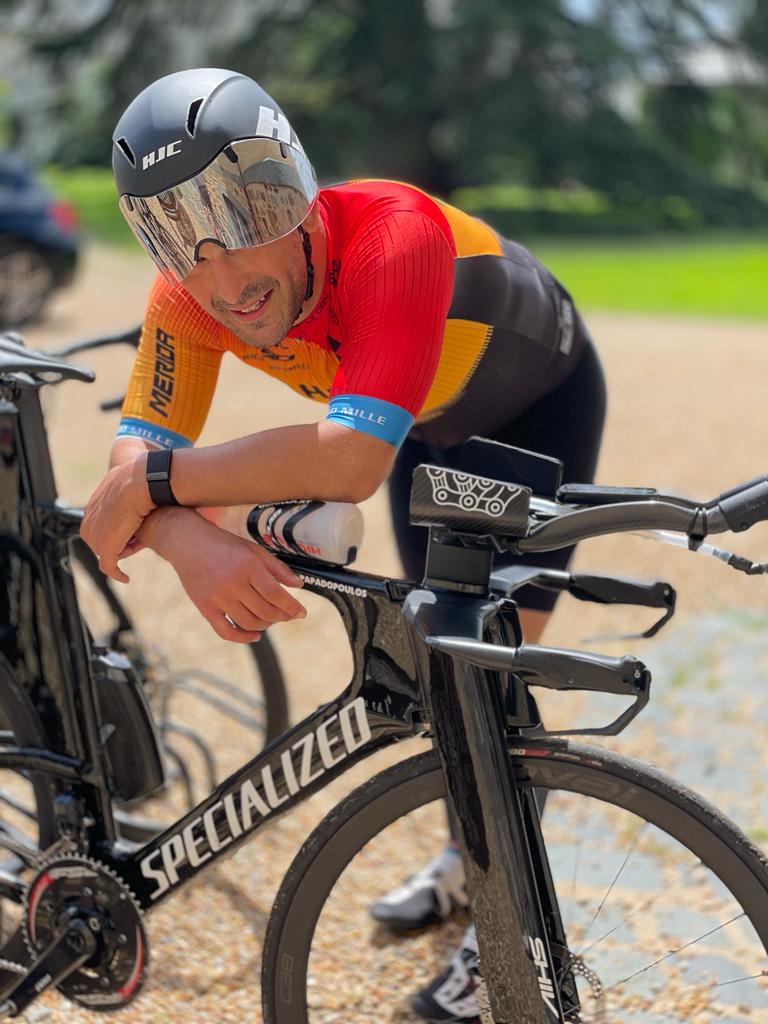
Bike Optimisation Assessment
£225.00
Which bike is actually faster for your race?
This isn’t just an aero number — it’s a position question, a power-delivery question, and a physiological cost question, together. This test films your position on each bike, measures how effectively you’re actually putting power through the pedals on each, and captures your physiological cost at matched wattage — on flat or on a climb gradient, your choice. See what actually changes when you swap bikes, not just what the spec sheet claims.
Beschreibung
A bike choice decision usually gets made on a spec sheet — frontal area, weight, tyre rolling resistance — none of which tell you what actually happens to your position, how well you can actually deliver power, or your breathing once you’re really riding it. This test measures all three directly, on two bikes, at a matched wattage, on whichever terrain the decision actually hinges on: flat, where aero position pays off most, or a sustained climb gradient, where position and power delivery matter more than drag.
Position and video analysis. Side-profile video captures your riding position on each bike — trunk angle, hip angle, how compressed or open your torso is — compared directly, bike to bike, at the same effort and terrain.
Force and power-delivery analysis. Vicon Blue Trident IMU sensors and pedal force data capture how effectively you’re actually applying power through the stroke on each bike — peak force timing, left/right balance, and how smooth or spiky your power delivery is. A position that looks more aero on video can still be quietly costing you clean power application, and this is the only part of the test that would catch it.
Physiology at matched effort. Alongside video and force, your oxygen cost, fuel mix and ventilation are captured at the same wattage on both bikes — so you find out whether a more aero or more compressed position is costing you physiologically, not just mechanically.
Relevant sectional analysis — what your report breaks down:
1. Test conditions — the two bikes, terrain tested (flat or gradient), matched wattage, and anything logged as a potential confound (see below).
2. Position comparison — trunk angle, hip angle and torso compression, side by side, bike to bike.
3. Force / power-delivery comparison — force effectiveness through the pedal stroke, peak force timing, left/right balance, and stroke smoothness, bike to bike.
4. Economy (VO2) A vs B — oxygen cost at the matched wattage on each bike.
5. Economy difference (%) — banded as noise (<~1.5%), a real and useful difference (1.5–3%), or large (>3%), so you know whether it’s worth acting on.
6. Cost of transport / efficiency — energy cost per unit distance at the tested wattage, normalised to actual race-relevant output.
7. Supporting markers — RER and HR at matched wattage, and VE (ventilation) read alongside the position comparison — a more compressed position that raises the metabolic cost of breathing is exactly the kind of cost video alone can’t show.
8. Terrain-specific read — if tested on a gradient, the unavoidable cost of climbing is separated from the actual bike-choice effect.
9. Performance translation — where your target wattage is known, the economy difference is translated into an estimated sustainable-power gain for the more economical bike, at the tested condition.
10. Reading position, force and physiology together — the actual point of running all three: whether a position you can see on video is letting you deliver power cleanly, and whether that combination is costing or saving you physiologically. Any one of the three in isolation only tells part of the story.
Confounds we control for, not just measure around:
– Road vs TT: the position/frame difference is the variable under test — bike mass and tyres should be matched or logged, so a heavier or higher-rolling-resistance bike doesn’t get mistaken for a “less economical position.”
– Road vs gravel: tyre width, tread and pressure typically differ more between these two than anything else about the bikes, and can be a bigger factor than frame or position — logged and flagged explicitly rather than left to contaminate the read.
Recommended for: anyone deciding between bikes for a specific hilly race, or wanting to know whether an aero position is actually paying for itself once position, power delivery and physiology are all on the table.
Ähnliche Produkte
-

Nutrition blood test
Preisspanne: £250.00 bis £600.00 Optionen auswählen Dieses Produkt weist mehrere Varianten auf. Die Optionen können auf der Produktseite gewählt werden -

FATMAX & Metabolic Efficiency Test
£140.00 Optionen auswählen -

Threshold & Training Zone Assessment
£150.00 Optionen auswählen -

Bone Density Analysis
£95.00 Optionen auswählen
 Deutsch
  English (UK)
  Français
  Español
  Italiano
  Nederlands (België)