
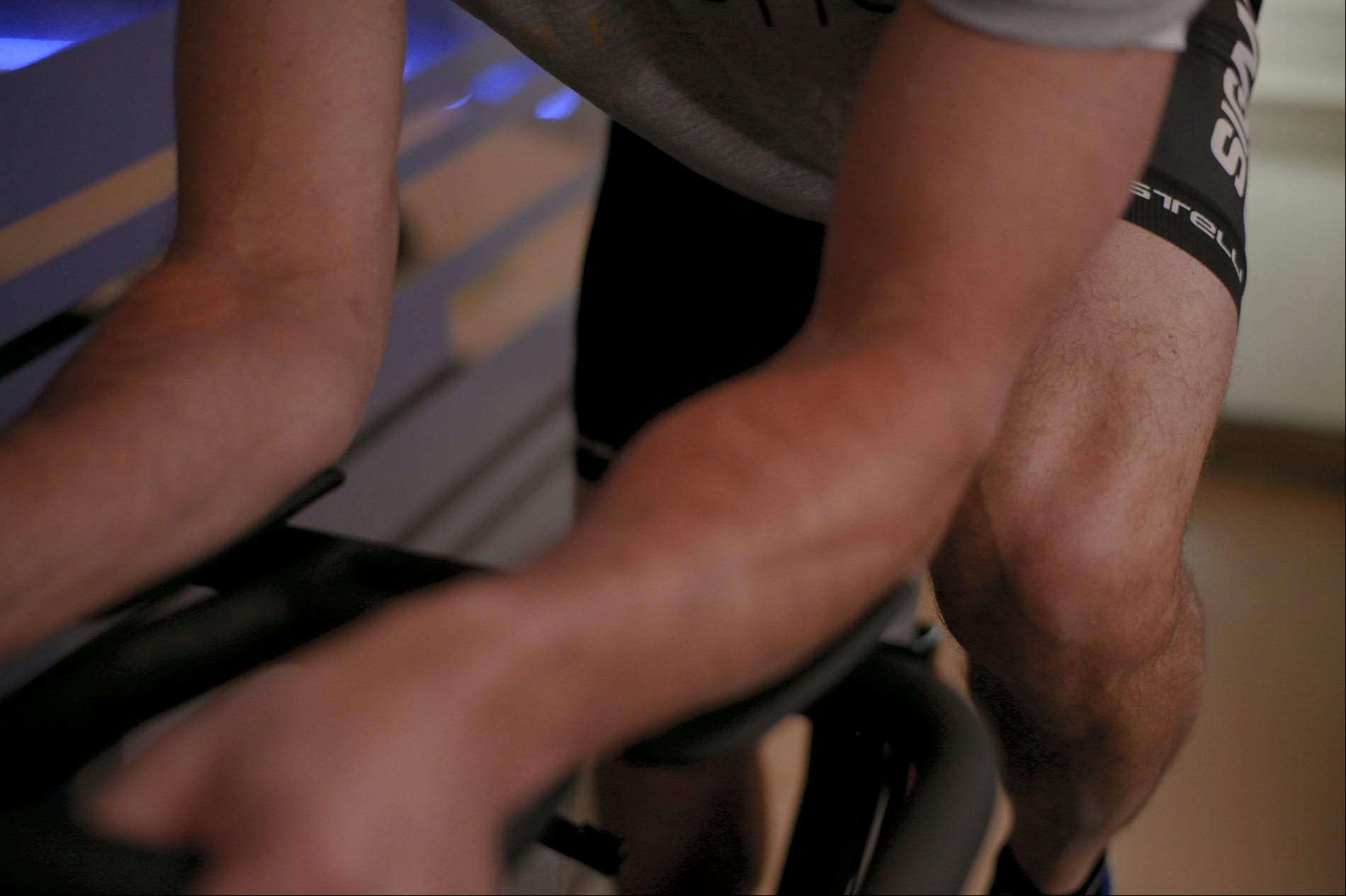
Fatigue Resistance | Biomechanics
£300.00
Your Engine is Strong. But is Your Chassis Collapsing Under Load?
You can have a world-class aerobic engine, but if your movement mechanics collapse after two hours of racing, you will leak speed, waste energy, and invite acute injury. Our Biomechanical Fatigue Resistance & Structural Durability Scan explicitly measures your physical resilience — how well your joints, tendons, and muscles maintain a clean, efficient line of motion as exhaustion sets in. Bypassing short, rested treadmill checks, we utilize a specialized split-test “sandwich” protocol. By choosing to pair a Cardiopulmonary Exercise Test (CPET) with research-grade Vicon Blue Trident inertial sensors and high-speed video capture, we can test your movement economy and efficiency when you are completely fresh, and re-test you immediately after a grueling, multi-hour depletion block. Discover exactly where your stride breaks down, how your braking forces multiply, and which joints are paying the price when you tire late in a race. Includes dual-phase mechanical economy profiling, 3D inertial shock wave tracking, and a comprehensive structural longevity prescription.
Beschreibung
Structural Durability: The Deflector Shield Against Late-Race Collapse
In endurance sports, performance is a race against efficiency decay. When you are fresh in the first hour, your running stride or cycling mechanics are naturally crisp: your core stays stable, your feet snap off the ground, and your joints absorb impact beautifully. But as the hours tick by, deep postural muscles tire, nervous system recruitment slows, and your biomechanical symmetry begins to unravel. This is the breakdown of Biomechanical Fatigue Resistance.
The Dynamic Architecture of the Split-Test Protocol
To isolate structural breakdown, we evaluate your biomechanics under a strict, 3-stage baseline and depletion protocol:
Phase 1: The Fresh Mechanical Blueprint (15 Minutes)
Equipped with clinical-grade Vicon Blue Trident IMU sensors on your lower limbs and, optionally, the CardioCoach Pro metabolic mask, you will execute a 10-minute steady-state block at your target race pace. This maps your optimal movement economy, joint angles, and baseline skeletal shock absorption when your body is fully rested.
Phase 2: The Exhaustion Block (2 to 3 Hours)
The sensors and mask are paused, allowing you to ride, run, or row continuously at a steady Zone 2 effort to systematically drain your muscular energy reserves.
Cycling targets: 1,500 to 2,500 Kilojoules (kJ) of total work done.
Running/Rowing targets: 1,200 to 2,000 calories burned.
Phase 3: The Fatigued Structural Re-Test (15 Minutes)
Within 90 seconds of hitting your fatigue threshold, the Vicon sensors (and CPET mask if added) are synchronized. You step right back onto the apparatus and repeat the exact same 10-minute steady-state block from Phase 1. Same speed, same power, same incline. We capture exactly how your structural framework has altered under the weight of exhaustion.
What the Data Unmasks: The Three Structural Failure Points
By overlaying your fresh data directly against your fatigued data, our applied biomechanics software exposes your precise mechanical “leaks”:
1. Kinetic Leaks & Stability Decay
Our Vicon Blue Trident sensors track micro-movements of angular velocity at the ankle and knee down to the millisecond. As you tire, does your foot strike slip into excessive pronation? Does your knee begin to track laterally? Any deviation from a straight line represents a kinetic leak—energy that should be pushing you forward is instead being wasted sideways, forcing stabilizing muscles to overwork.
2. Braking Force Shock Wave Multipliers
When fresh, your tendons act like highly efficient rubber bands, storing and releasing ground impact energy for free momentum. Under fatigue, your muscles stiffen, your strides shorten, and your ground contact times lengthen. We measure the peak tibial shock wave (G-forces) traveling up your lower legs. If your braking forces multiply in Phase 3, you have lost your elastic bounce and are actively slamming your joints into the ground with every step.
3. Metabolic Creep (VO2 Deficit)
Because we can run the CardioCoach Pro alongside our Vicon sensors, we measure the direct metabolic cost of your mechanical breakdown. If your body requires 3% to 8% more oxygen to maintain the exact same speed in Phase 3 compared to Phase 1, it proves your structural breakdown is actively draining your gas tank, choking your performance before you ever cross the finish line.
What’s Included in Your Assessment
The Full 3-Hour Biomechanical Split Protocol: Comprehensive laboratory booking comparing fresh vs. exhausted structural movement lines.
Vicon Blue Trident Multi-Sensor Telemetry: High-frequency, research-grade inertial tracking mapping tibial shock, ankle roll, and rotation velocities.
High-Speed Slow-Motion Video Overlay: Clear visual reference of your structural posture, hip drop, and foot placement under extreme load.
Targeted Strength & Structural Strategy Plan: A specialized report identifying your exact joint limiters, combined with a corrective strength, conditioning, and gait cueing prescription to eliminate late-race collapse.
Important Session Preparation Rules
Fresh Legs Required: Do not perform any exhaustive long runs, intense intervals, or heavy lower-body weight training within the 48 hours prior to your lab slot.
Gear Standardization: Bring the exact shoes, custom insoles, orthotics, or cycling kit you intend to wear during your primary race.
Nutritional Windows: Eat lightly before the session. Avoid large meals for 2 to 3 hours prior to ensure complete comfort while wearing the metabolic mask.
What to Wear: Running or cycling shorts are mandatory (rather than long compression tights) to allow our specialists to precisely place the Vicon Blue Trident sensors directly onto the bony landmarks of your lower leg and knee.


 Deutsch
  English (UK)
  Français
  Español
  Italiano
  Nederlands (België)